Techniques · April 2026
Trimming Tools and Why They Matter
The wheel does not stop at throwing. Trimming is where a piece finds its final weight, its foot, its balance. A look at the tools involved and what each one does.
Most people think the work is done when the clay leaves the wheel after throwing. In reality, trimming is half the job. It is where excess clay is removed from the base, the foot ring is defined, and the final profile of a piece is refined.
Trimming happens when the clay has dried to leather-hard — firm enough to hold its shape under the tool, soft enough to cut cleanly.
01
Loop Tools
“The workhorse of the trimming process.”
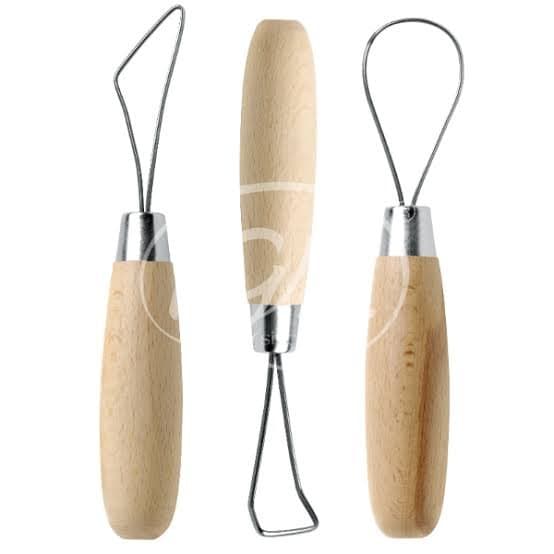
Loop tools are the most common trimming tool — a wire or metal loop attached to a handle, used to cut away clay in controlled passes. They come in round, square, and teardrop profiles, each leaving a slightly different cut texture on the surface.
A round loop removes clay quickly and leaves a smooth, curved surface. Square loops cut more aggressively and are used for defining sharp transitions and foot ring walls.
The gauge of the wire matters. Thicker wire removes more material per pass but requires more pressure. Thinner wire cuts more precisely and is better for detailed work near the foot ring.
Technique
Hold the tool at a consistent angle and let the spinning wheel do the work. Moving the tool rather than pressing harder gives you more control.
02
Ribbon Tools
“More control, less material removal.”
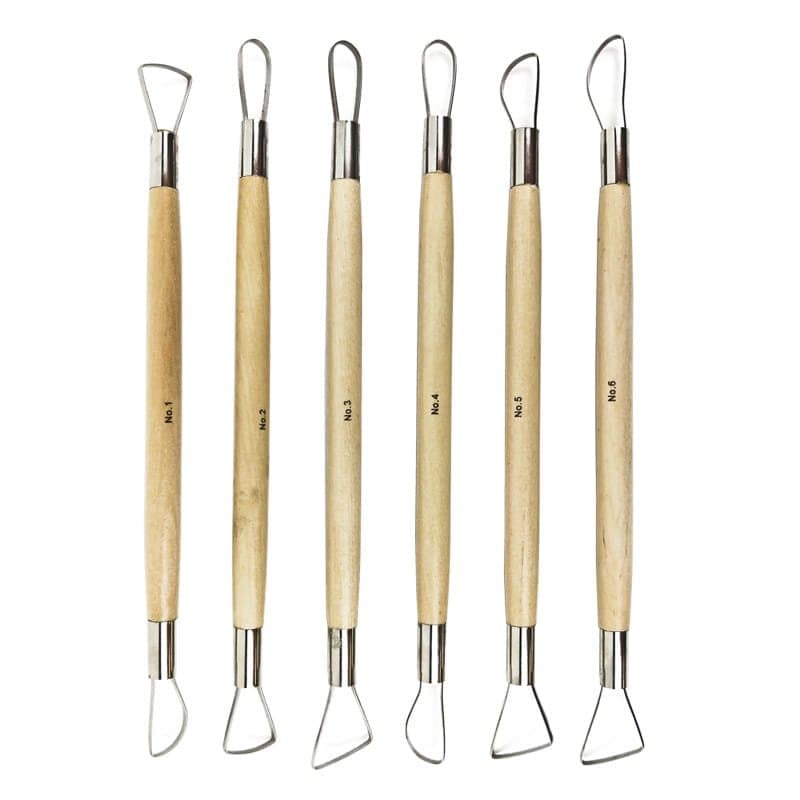
Ribbon tools have a flat blade with a bevelled or sharpened edge — less aggressive than a loop, better suited for smoothing and refining. They are particularly useful on the outside walls where you want to remove surface imperfections without significantly changing the profile.
A ribbon tool is often the last tool used in a trimming session. After the loop tool has done the heavy work, the ribbon tool smooths everything out.
Some makers use a ribbon tool exclusively on softer leather-hard clay. On firmer clay, the tool skips rather than cuts cleanly — a sign that the piece has dried too far for safe trimming.
When to use it
The ribbon tool is best used on clay that is just past leather-hard. If the clay is powdering as you cut, it is too dry. If it is dragging and smearing, it is too wet.
03
Needle Tools & Hole Cutters
“Precision work in the final stages.”
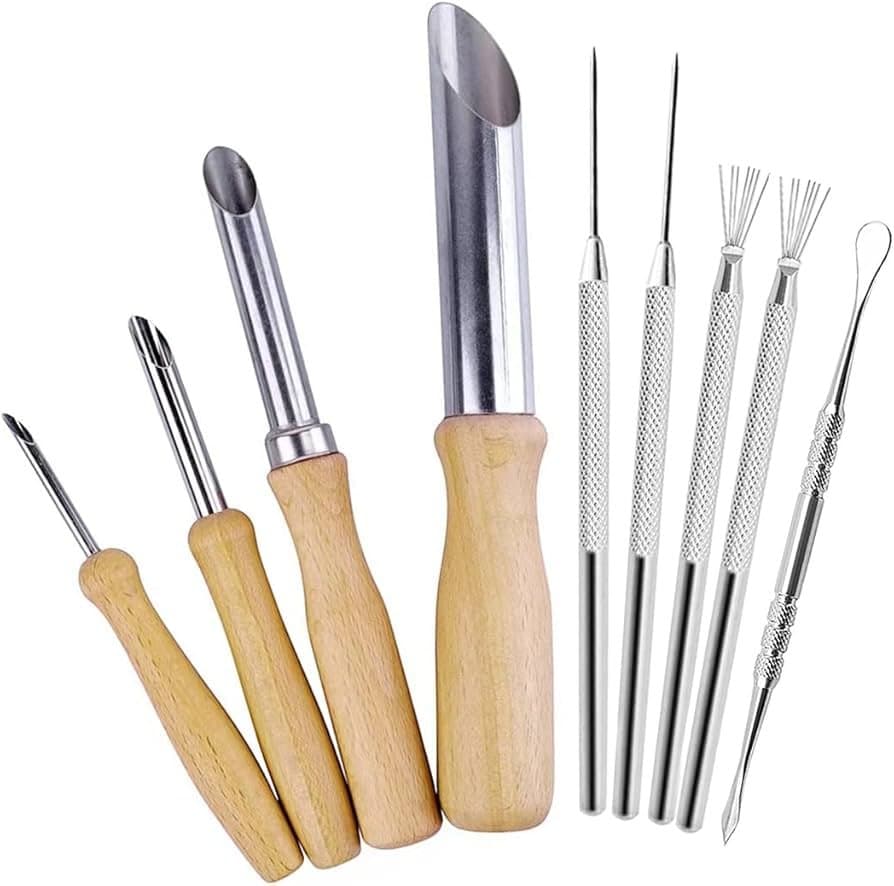
A needle tool is not primarily a trimming tool — but it is essential at the trimming stage. Used to test the thickness of the base by pressing gently through the clay, it tells you exactly how much more clay you can safely remove.
Push the needle straight down through the centre of the base until you feel resistance. Pull it out and measure with your finger against the wheel head. Most functional ware sits between 5 and 8mm at the base.
Hole cutters are specialised tools for adding drainage holes to planters, colanders, and strainer forms. They cut clean circles without cracking the surrounding clay.
The foot ring
The foot ring is the signature of the trimming process — a raised ring on the base that lifts the piece slightly and gives the glaze somewhere to stop. A well-trimmed foot ring is even in height and width, sits flat, and complements the form.
Trimming is where a thrown piece becomes a finished object. The difference between a piece that feels right in the hand and one that feels heavy or awkward often comes down to what happened — or did not happen — at this stage.
The tools are simple. What matters is developing the feel for when to cut and when to stop.
See the work that comes from these techniques.
Every piece in the collection is hand built in Fremantle.